
Millberry copper wire scrap: a wholesale buyer’s guide
Updated
SHORT ANSWER
Millberry is clean, bare copper wire scrap purchased as industrial feedstock, not as electrical cable. Buyers should define the grade in writing, inspect inside each lot, verify chemistry and contamination through agreed sampling, and settle on net dry weight. Historical prices are only reference points; every shipment needs a current lot-specific offer.
Key takeaways
- The name Millberry does not replace a written purchase specification or independent inspection.
- Bare bright appearance cannot prove chemistry, internal contamination or dry net weight.
- Millberry is remelting feedstock and must never be treated as certified installation cable.
What Millberry copper wire scrap is
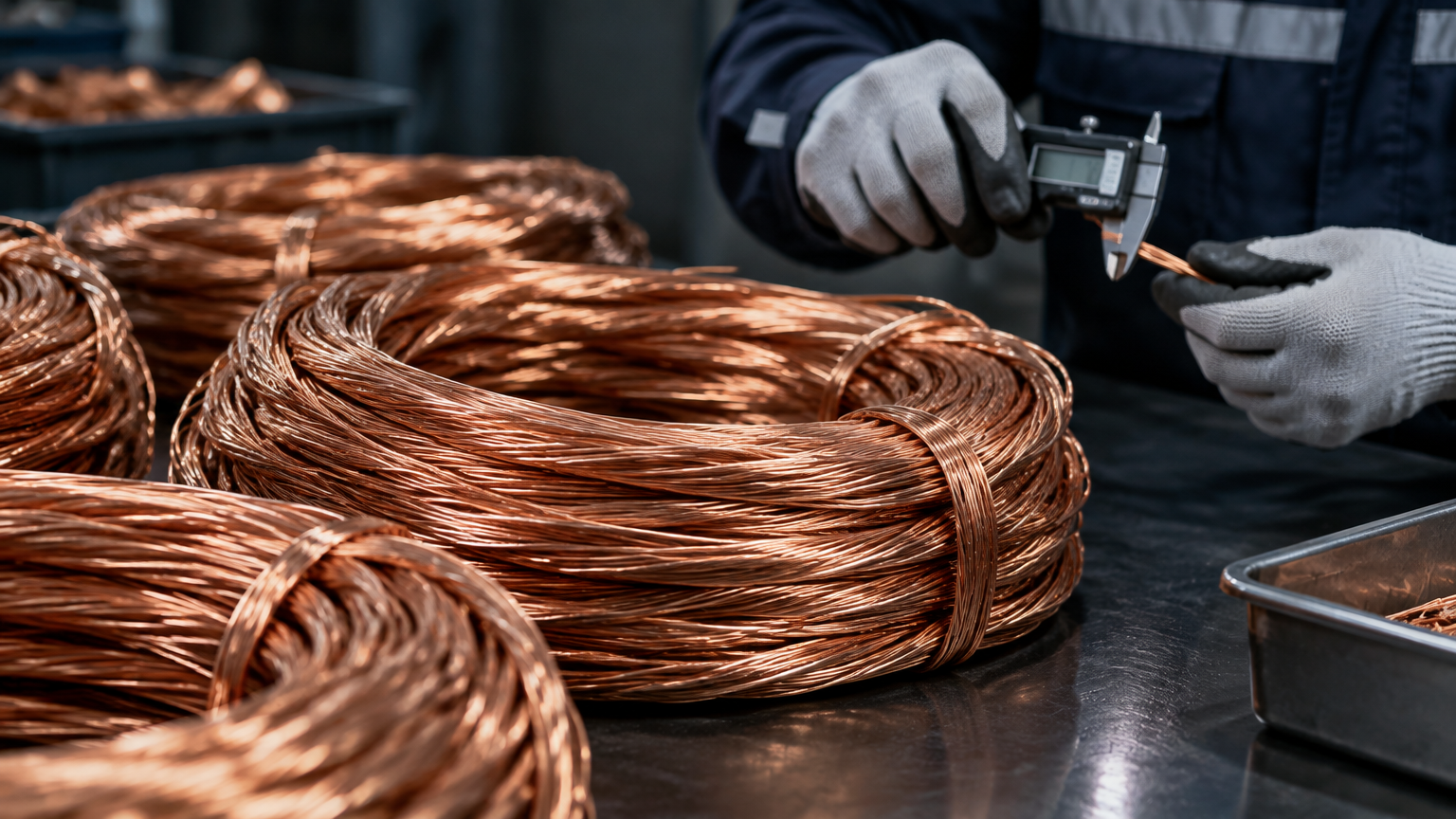
Millberry is a trade description for clean, bare copper wire scrap. It usually comes from stripped electrical cable, transformer windings or industrial harnesses. The name does not identify a brand. A purchase contract must define the accepted wire size, coating, oxidation, attachments, contamination and assay basis. Purity figures shown in marketplace listings are seller claims until the shipment is sampled and independently verified.
- Feedstock for copper remelting and secondary refining
- Input for wire-drawing mills producing new conductors
- A bulk commodity for recyclers, foundries and metal traders
- Not a substitute for insulated, certified electrical cable
Why industrial demand has grown
Recyclers and remelters value consistent bare copper because coatings, solder and insulation add processing work and can reduce usable yield. Tighter documentation requirements also make traceable, segregated lots more useful than mixed bundles. Millberry remains industrial feedstock. It has no insulation, voltage rating or finished-cable certification for direct electrical installation.
Common sourcing methods
The right channel depends on volume, inspection access and documentation. The figures below are approximate USD conversions of the source guide’s July 2025 Indian-market ranges, using INR 86 = USD 1. They are historical reference points, not Souq Ore offers or current market quotations.
| Method | Advantages | Risks | Indicative cost |
|---|---|---|---|
| Direct mill or recycler | Batch verification, bulk pricing, traceable source | Minimum volumes, payment and logistics coordination | USD 9.30–10.70/kg |
| Alibaba marketplace suppliers | Supplier comparison and packaging options | Documentation and testing quality vary by listing | USD 9.65–11.05/kg |
| Local scrap yards | Immediate inspection and no long-distance freight | Misgrading, inconsistent weights and no assay | USD 8.72–10.23/kg |
Specifications to inspect before payment
Bright appearance alone does not prove a Millberry lot. Agree a representative sampling method and acceptance limits before funds move. A photograph cannot establish chemistry, internal contamination or dry net weight.
- Assay: verify the contracted copper content through an agreed independent method
- Physical state: reject plastic, rubber, enamel, tin, solder and attached fittings beyond tolerance
- Condition: inspect for green patina, black oxide, oil, moisture and sticky residue
- Uniformity: open compressed bundles and inspect their interior, not only the outer layer
- Weight: specify calibrated scales, net weight and dry basis in the contract
Advantages, limits and suitable buyers
A clean, verified lot can reduce sorting and pre-treatment before remelting. Bare copper scrap also has established wholesale liquidity. Its limits are equally clear: no electrical safety certification, no finished-cable gauge label and susceptibility to oxidation if stored wet. It suits metal recyclers, foundries, secondary refiners, wire-drawing mills and commodity traders. It does not suit home wiring, audio assemblies, data cables or any use requiring insulation and an electrical rating.
A five-step buying checklist
Treat the grade name as the start of due diligence, not the conclusion. Record every acceptance point in the purchase specification and inspection instruction.
- Confirm that the intended use is industrial remelting or refining
- Define grade, wire dimensions, chemistry and contamination tolerances in writing
- Appoint inspection, sampling and assay procedures before acceptance
- Open mixed or compressed bundles and reject concealed off-grade material
- Set net dry weight, packing, seal and documentary requirements in the contract
Historical cost comparison in US dollars
Using the same INR 86 = USD 1 conversion basis, the source guide’s mid-2025 Millberry range equals about USD 9.30–10.70 per kg, or USD 9,300–10,700 per metric ton. Its comparison range for standard No. 1 bare bright copper equals about USD 7.91–8.84 per kg. PVC-insulated copper scrap converts to about USD 4.88–6.40 per kg. These numbers do not include freight, inspection, finance, duties or taxes. Current offers should reference the agreed copper benchmark, lot assay, location and Incoterm.
When another copper product is the right choice
Millberry is raw scrap, not functional cable. Finished applications require purpose-built products with the correct insulation, conductor size, connectors and certification.
| Use | Suitable product | Why Millberry does not fit |
|---|---|---|
| Home audio | Insulated OFC stranded speaker cable of the specified gauge | No insulation, gauge marking or safety rating |
| USB-C or HDMI | Protocol-certified finished cable | No shielding, connectors or data construction |
| Low-voltage outdoor power | Rated tinned copper cable selected by an electrical professional | Bare wire lacks weather protection and an ampacity rating |
Storage, handling and legal checks
Store bare copper indoors on pallets, clear of damp floors, and protect it from rain and condensation. Gloves and eye protection reduce injury from fine strands and sharp ends. Import, export, recycling and traceability rules differ by origin and destination. Confirm the shipment’s current requirements with the relevant authorities and licensed advisers before contracting. Do not reuse another market’s permits or thresholds as a substitute for transaction-specific advice.
The buying decision
Choose Millberry only when the operation needs clean, bare copper feedstock and the seller accepts a written specification, representative inspection and documentary controls. Choose certified finished cable for electrical, audio, power or data transmission. Confusing scrap feedstock with an installation product creates avoidable cost and safety risk.
Questions buyers ask next
- What is the price of Millberry copper per kg?
- The source guide’s mid-2025 Indian-market range converts to approximately USD 9.30–10.70 per kg at INR 86 to USD 1. Treat that as historical context only. Current value depends on the copper benchmark, assay, contamination, volume, location, packing and delivery term.
- What is Millberry copper used for?
- It is used as high-grade feedstock for remelting, secondary refining and wire-drawing operations. It is not a finished consumer cable and should not be installed in electrical or electronic systems.
- Which is the best copper wire?
- There is no single best wire. Finished electrical uses require a cable designed and certified for the voltage, current, environment and protocol. Millberry is scrap feedstock, so it belongs in an industrial recycling specification rather than a cable comparison.
- What is the price of 1 kg of copper wire?
- The source guide’s retail insulated-wire comparison converts to about USD 1.40–3.26 per kg at the stated exchange basis, while its Millberry scrap range converts to about USD 9.30–10.70 per kg. The products serve different markets, and live prices require a current specification and quotation.
- Is Millberry copper cable wire available for local purchase?
- Industrial scrap yards, recyclers and Alibaba marketplace suppliers may advertise bulk lots. Availability does not establish grade. Verify the seller, inspect the specific lot and agree assay, net dry weight, packing and rejection terms before payment.