
COLTAN · TANTALUM & NIOBIUM
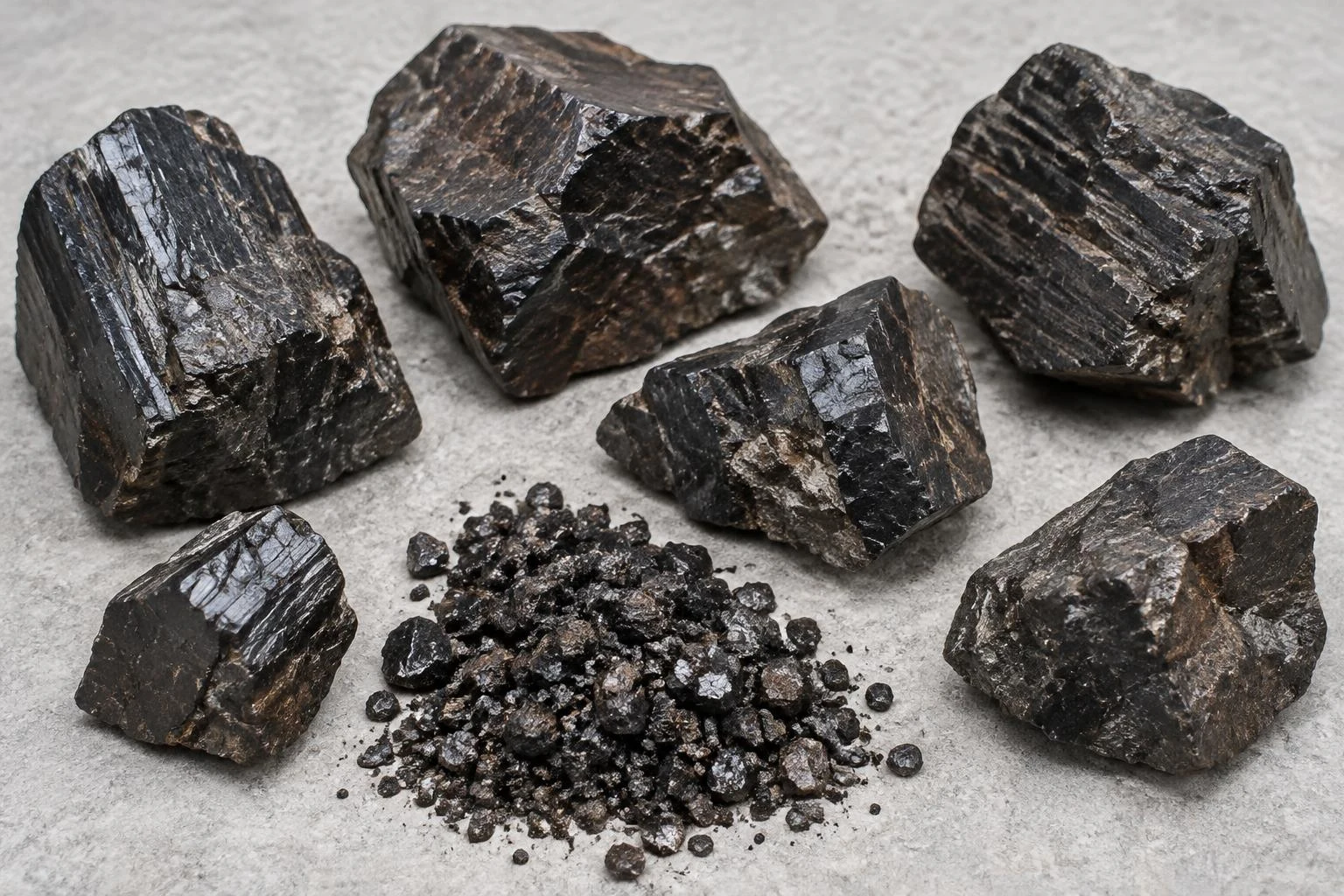
Coltan columbite-tantalite mineral ore
Coltan is a commercial name for columbite-tantalite mineral material containing niobium and tantalum. Souq Ore welcomes qualified B2B sourcing enquiries for identified ore or concentrate lots. Value depends on representative dry-basis assay, lawful origin, payable oxide content and the buyer's processing specification, not the name on a bag.
For tantalum and niobium processors, refiners and qualified industrial mineral buyers
AT A GLANCE
What does Souq Ore supply as coltan (columbite-tantalite)?
Coltan is a commercial name for columbite-tantalite mineral material containing niobium and tantalum. Souq Ore welcomes qualified B2B sourcing enquiries for identified ore or concentrate lots. Value depends on representative dry-basis assay, lawful origin, payable oxide content and the buyer's processing specification, not the name on a bag.
| Origin | Mine, country and chain of custody verified for the identified lot; no blanket origin claim |
|---|---|
| Buyer profile | For tantalum and niobium processors, refiners and qualified industrial mineral buyers |
| Tests and checks | Lot identity & physical form · Ta2O5 and Nb2O5, dry basis · Moisture and dry weight · Associated elements & gangue · Uranium, thorium & cargo classification · Payable content & acceptance |
| Lot documents | 6 document types per lot, released after KYC |
| Delivery gateways | KWI · MCT · BAH · DOH · RUH · JED · DXB · AMM · JFK · LAX · BKK · PVG · PEK · HKG · NRT · HND · TPE |
| Commercial basis | Lot-specific, under signed contract after KYC and due diligence |
TECHNICAL CONTEXT
What is coltan, and what does a buyer actually purchase?
Coltan is not a refined metal, a single fixed-grade product or a universal mineral species. The name combines columbite, which is niobium-dominant, and tantalite, which is tantalum-dominant. These related oxide minerals contain iron and/or manganese as well as niobium and tantalum. Their composition varies, and a mined parcel can contain additional minerals and gangue.
Run-of-mine ore, washed material and gravity concentrate are different purchase specifications. Concentration removes part of the unwanted material and can increase the reported oxide grade, but it does not produce capacitor-grade tantalum. A processor still needs suitable feed, validated chemistry and a documented refining route. No current stock, minimum grade, monthly capacity or mine ownership is implied by this page.
SPECIFICATION FRAMEWORK
What is measured. How it is tested. What governs acceptance.
| Parameter | Test / inspection method | Acceptance basis |
|---|---|---|
| Lot identity & physical form | Mine and supplier records, bag or drum schedule, seal reconciliation and representative inspection | State ore or concentrate, particle size, lot mass and custody references |
| Ta2O5 and Nb2O5, dry basis | Representative composite sampling; validated fusion/XRF or fusion/ICP analysis appropriate to refractory oxides | Report both oxides separately with method, detection limits and agreed assay tolerance |
| Moisture and dry weight | Agreed drying protocol on sealed representative moisture samples; calibrated weighing | Keep wet mass, moisture fraction and dry mass distinct in settlement |
| Associated elements & gangue | Buyer-agreed multi-element analysis, including relevant iron, manganese, tin, tungsten and silica | Processor-specific impurity limits, penalties and rejection thresholds |
| Uranium, thorium & cargo classification | Appropriate elemental and radiological assessment where required; review the actual transport mode and jurisdiction | Do not assume all coltan is radioactive or that every parcel is non-dangerous cargo |
| Payable content & acceptance | Reconcile accepted dry-basis assay with dry mass and the written purchase formula | Benchmark unit/date, payability, niobium credit, charges and umpire procedure fixed by contract |
COLTAN BUYER GUIDE
From mineral chemistry to a defensible buying decision
Key characteristics & composition
Columbite-tantalite minerals are dense, typically dark oxide minerals with variable niobium-to-tantalum ratios. The general compositional expression (Fe,Mn)(Nb,Ta)2O6 describes iron/manganese and niobium/tantalum substitution; it is not a guaranteed formula for a mixed commercial parcel. Columbite is niobium-dominant and tantalite is tantalum-dominant on the relevant mineral sites.
Commercial assays commonly express tantalum as Ta2O5 and niobium as Nb2O5 oxide equivalents. These are reporting conventions for composition, not proof that a parcel is chemically pure pentoxide. Elemental Ta is approximately 81.9% of Ta2O5 by mass; elemental Nb is approximately 69.9% of Nb2O5. Never compare an elemental percentage with an oxide percentage without conversion.
- Appearance: commonly black to brown-black, opaque, with submetallic to vitreous lustre; colour alone is not diagnostic.
- Hardness: commonly about 6 on the Mohs scale for columbite-tantalite minerals; mixed ore does not have one uniform hardness.
- Density: increases toward tantalum-rich compositions; quartz, feldspar and other gangue change the bulk parcel density.
- Associated minerals: cassiterite, other tantalum oxides and tungsten minerals may occur, depending on the deposit. Test the actual lot.
Main uses of tantalum and niobium from coltan
Coltan's industrial importance comes from the refined tantalum and niobium recovered from suitable mineral feed. Downstream manufacturers do not place raw coltan directly into phones, aircraft or medical implants. Separation, chemical purification and controlled metal production come first, and each end use has its own specification.
- Electronics: tantalum powder and wire are used in capacitors. A stable tantalum oxide dielectric supports high capacitance in compact components for consumer, automotive and industrial electronics.
- Aerospace and high-temperature engineering: tantalum contributes to selected nickel-based superalloys; tantalum carbide is used in hard, wear-resistant materials.
- Chemical processing: tantalum's corrosion resistance supports selected heat exchangers, vessel linings and process components. Compatibility depends on the actual chemical environment.
- Medical engineering: suitably processed tantalum is used in selected implants and devices because of its biocompatibility. An ore assay is not a medical-grade material certificate.
- Steel and superconductors: niobium is widely used in high-strength low-alloy steel and in superconducting alloys such as Nb-Ti and Nb3Sn. Most primary niobium supply comes from pyrochlore deposits, not coltan.
Global distribution & mining
Tantalum-bearing minerals occur in several regions, and mining statistics for tantalum are not identical to coltan production statistics. USGS Mineral Commodity Summaries distinguish contained tantalum from ore tonnage. Production, reserves and resources measure different things, so a country's reported metal output cannot be treated as the weight of coltan shipped or as a guaranteed mine reserve.
Geologically, columbite-tantalite is associated with evolved granitic pegmatites and some related granitic systems. Weathering can release resistant heavy minerals into eluvial and alluvial deposits. Hard-rock operations may use crushing, screening and gravity separation; alluvial operations may recover heavy minerals by washing and gravity methods. Plant selection, recoveries, water management and rehabilitation depend on the deposit and permits.
- Central and East Africa: the Democratic Republic of the Congo and Rwanda are major reported tantalum-producing countries. Reported national output does not establish the mine origin of a specific parcel.
- Other African production: Nigeria and Mozambique feature in USGS tantalum production tables; Ethiopia and Burundi also appear in the reported producer group.
- Outside Africa: Brazil and Australia are important in the wider tantalum supply picture, including pegmatite-related production and recovery associated with other minerals.
- Niobium is a different supply map: Brazil dominates primary niobium production, with Canada also significant. This does not mean Brazil dominates all coltan or tantalum mining.
| Country / total | Contained Ta (tonnes) |
|---|---|
| Democratic Republic of the Congo | 1,300 |
| Rwanda | 400 |
| Nigeria | 390 |
| Brazil | 190 |
| China | 80 |
| Australia | 50 |
| Ethiopia | 40 |
| Russia | 30 |
| Bolivia | 2 |
| Burundi | 2 |
| Mozambique | 1 |
| World total (rounded) | 2,500 |
These estimates measure contained tantalum, not coltan tonnage or Ta2O5. The rounded world total need not equal the sum of country estimates. USGS revised earlier 2024 figures in its 2026 edition; do not infer growth by comparing unrevised figures from different editions. National production is not proof of a supplier's mine origin.
Sampling, beneficiation and assay: what settles the grade?
Representative sampling determines whether an assay can speak for the lot. Heavy mineral grains can segregate by size and density during handling, while wet fines and rich fragments can distort a casual grab sample. Agree where increments are taken, how they are combined and reduced, and how buyer, seller and retained umpire splits are sealed and recorded.
Columbite-tantalite contains refractory oxides, so incomplete digestion can produce misleading analytical results. A competent laboratory should use a validated preparation and measurement method suitable for this matrix, with appropriate reference materials and quality control. Handheld XRF may assist screening; a surface spot result is not a substitute for a contractually accepted composite assay.
Responsible sourcing, traceability and lawful trade
Responsible coltan sourcing is an evidence-based process, not a country label or a blanket conflict-free promise. Tantalum belongs to the tin, tantalum, tungsten and gold group commonly called 3TG. The OECD minerals guidance provides a risk-based due-diligence framework for supply chains from conflict-affected and high-risk areas, wherever those areas are located.
Applicable obligations depend on the buyer, mineral form, destination and legal thresholds. EU Regulation 2017/821 sets supply-chain due-diligence obligations for covered Union importers of specified tin, tantalum, tungsten and gold minerals and metals; US conflict-minerals disclosure rules apply to covered issuers under their own scope. Neither framework makes every ore parcel automatically certified. Review the actual transaction with qualified advisers.
- Identify the mine and exporter, beneficial ownership, licences and export documents relevant to the lot.
- Reconcile custody, transport and trading records; assess human-rights, armed-group, corruption and sanctions risks.
- Escalate inconsistent origin claims, missing records or implausible volumes before purchase rather than treating a bag tag as conclusive proof.
How much is 1 kilogram of coltan worth?
One kilogram of coltan has no universal USD value. The price of contained tantalum oxide is not the price of one kilogram of ore, and a dated published benchmark is not a binding supplier quote. Obtain a current written offer against accepted assay results rather than using an undated online price range.
Historical benchmark, not today's price: USGS Mineral Commodity Summaries 2026 reports an estimated 2025 annual-average tantalite price of USD 180 per kilogram of contained Ta2O5, approximately USD 81.65 per pound. The assessment unit is contained oxide, not gross ore weight. USGS identifies Asian Metal as the 2025 price source. This historical annual average is not a current Souq Ore offer.
Illustrative tantalum-only value per wet kg = (1 − moisture fraction) × dry-basis Ta2O5 fraction × 2.20462 × USD/lb contained Ta2O5 × payable fraction. Then apply agreed niobium credits, penalties and charges. Use fractions: 30% = 0.30.
Worked example using that historical USD 180/kg contained Ta2O5 benchmark: assume 30% dry-basis Ta2O5, 5% moisture and a hypothetical 80% payability. One wet kilogram contains 0.95 kg dry material and 0.285 kg Ta2O5. The tantalum-only calculation is 0.95 × 0.30 × USD 180 × 0.80 = USD 41.04 per wet kg before niobium credits, treatment charges, penalties, taxes and freight. At hypothetical 100% payability it is USD 51.30. These are illustrative calculations, not current ore prices, guaranteed recovery or an offer.
Shipping, payment, acceptance and claims
Commercial terms must be written for the identified coltan lot. Route feasibility, export permissions, classification, packing and destination requirements are reviewed before any delivery commitment. No universal delivery time, flat freight charge or automatic refund right is advertised.
- Shipment: agree bag or drum weights, seals, moisture protection, transport classification, Incoterm and the approved receiving point. A gateway code does not establish cargo acceptance.
- Payment: agree the currency, benchmark date, payable formula, provisional or final settlement stages and verified corporate payment instructions in the signed contract.
- Acceptance: define independent sampling, assay tolerance, impurity limits, sealed retained samples and an umpire mechanism before release.
- Claims and cancellation: preserve seals, photographs, handover and inspection records. Written notification periods, remedies, committed costs and authorized returns follow the signed contract.
PRODUCT INQUIRY
Inquire about this item
Coltan (columbite-tantalite)
TEST CONTROL
From lot identity to buyer acceptance.
- 01
Verify origin
Identify the mine, exporter, beneficial owners and custody events. Review permits and risk indicators before any origin or responsible-sourcing claim.
- 02
Sample the lot
Agree increments across the lot, compositing, preparation, sealed splits and a separate moisture sample. A hand-picked rich fragment is not representative.
- 03
Assay & reconcile
Appoint a competent laboratory under the agreed scope. Report Ta2O5, Nb2O5 and specified impurities, then reconcile buyer, seller and umpire samples.
- 04
Contract & release
Confirm payability, inspection, cargo classification, packing, Incoterm and destination requirements before documented handover. Availability is confirmed separately.
LOT FILE
Expected transaction records
- Mine, supplier and export-origin evidence for the identified lot
- Bag or drum register, seals and chain-of-custody record
- Sampling, preparation, moisture and dry-weight records
- Lot-specific Ta2O5, Nb2O5 and impurity assay report
- Risk-based due-diligence and transport-classification evidence where required
- Shipment-specific export, packing and commercial documents when issued
Documents are released only when they exist for the identified lot and only to qualified parties through the secure channel.
DIRECT TECHNICAL ANSWERS
Buyer FAQs
Is coltan the same as tantalum?
No. Coltan is mineral feed containing tantalum and niobium compounds. Tantalum is an element recovered through processing and refining. Ore, oxide, metal powder and finished capacitors are different products.
How much is 1 kilogram of coltan worth?
There is no single price for one kilogram of coltan. A defensible quote needs dry-basis Ta2O5 and Nb2O5 assay, moisture, a dated benchmark with its unit, payable fractions, impurity terms and delivery costs. The worked example in this guide is arithmetic, not a current market quotation.
Does a high-density black rock prove coltan?
No. Colour, weight and magnet response are screening observations, not proof of mineral identity or payable grade. Mineralogical identification and representative chemical analysis are needed; surface-only readings cannot establish an entire lot's settlement value.
Can Ta2O5 and Nb2O5 be added together for pricing?
Not unless the purchase contract explicitly defines that basis. Tantalum and niobium have different markets, recovery routes and payable terms. A combined oxide percentage is not equivalent to the same percentage of Ta2O5.
Is coltan covered by the Kimberley Process?
No. The Kimberley Process concerns rough diamonds, not coltan. Tantalum sourcing requires relevant legal-origin evidence and risk-based supply-chain due diligence. A diamond certificate does not establish coltan compliance.
Is coltan automatically dangerous goods?
No universal classification can be assigned from the trade name alone. Uranium or thorium may occur in associated minerals, so elemental results and any required activity measurements must be evaluated against the applicable transport rules for the actual parcel.
What should a coltan RFQ include?
State company and intended processing use, ore or concentrate form, target quantity, requested Ta2O5 and Nb2O5 grades, impurity limits, inspection method and destination. Availability, lawful origin, delivery route and pricing are then assessed for a specific lot.
Are minimum grade and monthly tonnage guaranteed?
No permanent grade or capacity is advertised here. Any numeric specification, available quantity, sample access and delivery window must be supported by the identified lot and a transaction-specific offer.