
REFINED COPPER · WHOLESALE EXPORT
Copper cathode B2B wholesale export
Copper cathode is refined copper deposited electrolytically as solid metal sheets, not copper ore, concentrate or wire scrap. Souq Ore welcomes qualified B2B wholesale sourcing enquiries with grade, producer, chemical specification, net weight and delivery terms verified for each offered lot. A Grade A label is a claim to check, not proof of stock or quality.
For wire-rod mills, copper fabricators, alloy producers and qualified metal traders
AT A GLANCE
What does Souq Ore supply as copper cathode?
Copper cathode is refined copper deposited electrolytically as solid metal sheets, not copper ore, concentrate or wire scrap. Souq Ore welcomes qualified B2B wholesale sourcing enquiries with grade, producer, chemical specification, net weight and delivery terms verified for each offered lot. A Grade A label is a claim to check, not proof of stock or quality.
| Origin | Refinery, producer, country and custody verified for each offered lot; no blanket origin claim |
|---|---|
| Buyer profile | For wire-rod mills, copper fabricators, alloy producers and qualified metal traders |
| Tests and checks | Grade, standard & edition · Copper & specified impurities · Trace-element panel · Producer, brand & batch · Sheet dimensions & surface · Gross, tare & net metal weight · Packing & load security · Benchmark & quotation basis |
| Lot documents | 6 document types per lot, released after KYC |
| Delivery gateways | Destination seaport or receiving plant agreed per shipment; airport codes are not bulk cargo routes |
| Commercial basis | Lot-specific, under signed contract after KYC and due diligence |
TECHNICAL CONTEXT
Refined metal. Defined chemistry. Verified title.
Cathodes are an intermediate refined-metal product used to make copper wire rod, billets, tube and other fabricated forms. Electrorefining purifies copper from anodes; electrowinning recovers copper from a purified solution. Both can produce cathode, but a production method alone does not establish compliance with the buyer's grade. Chemistry, producer traceability and physical condition must be checked together.
Souq Ore assesses sourcing against the buyer's written specification rather than advertising permanent purity, refinery ownership, warehouse stock, monthly capacity or exchange approval. Identify the proposed producer, brand and batch, verify authority to sell, agree inspection and settle only under the transaction's signed terms. Standards explain the target; lot evidence establishes what is actually available.
SPECIFICATION FRAMEWORK
What is measured. How it is tested. What governs acceptance.
| Parameter | Test / inspection method | Acceptance basis |
|---|---|---|
| Grade, standard & edition | Compare producer certificate and independent results with the complete contracted standard | Specify BS EN 1978:2022 Cu-CATH-1 or the agreed ASTM B115 edition and grade; names are not interchangeable |
| Copper & specified impurities | Representative lot sampling and validated laboratory analysis with suitable detection limits | Cu-CATH-1 reference: listed impurities total ≤0.0065%; individual limits also apply. This is not an offered-lot assay |
| Trace-element panel | Agreed analysis for elements such as Bi, Sb, As, Pb, Fe, Ni, Se, Te and S | Use all individual and grouped limits in the chosen standard; a headline Cu percentage is insufficient |
| Producer, brand & batch | Verify markings, batch records, certificate authenticity and the official brand list if exchange status is claimed | Chemical conformity does not itself confer LME brand approval or exchange deliverability |
| Sheet dimensions & surface | Measure representative sheets; inspect deposits, nodules, contamination and handling damage | Dimensions, thickness, appearance and permitted defects are stated per lot; no universal sheet size assumed |
| Gross, tare & net metal weight | Calibrated weighbridge or scale records, bundle count and packing reconciliation | Payable mass is agreed net metal mass, excluding pallets and straps; weight tolerances are contractual |
| Packing & load security | Bundle weights, pallet condition, strapping, container payload and securing-plan review | Loading plan follows verified package weights, equipment limits and carrier acceptance |
| Benchmark & quotation basis | Reconcile net tonnes with the named copper price, pricing period and physical premium or discount | Specify cash or forward reference, currency, Incoterm, costs and settlement timing in writing |
COPPER CATHODE BUYER GUIDE
From specification to settlement: the copper cathode buyer guide
Key characteristics, specifications & composition
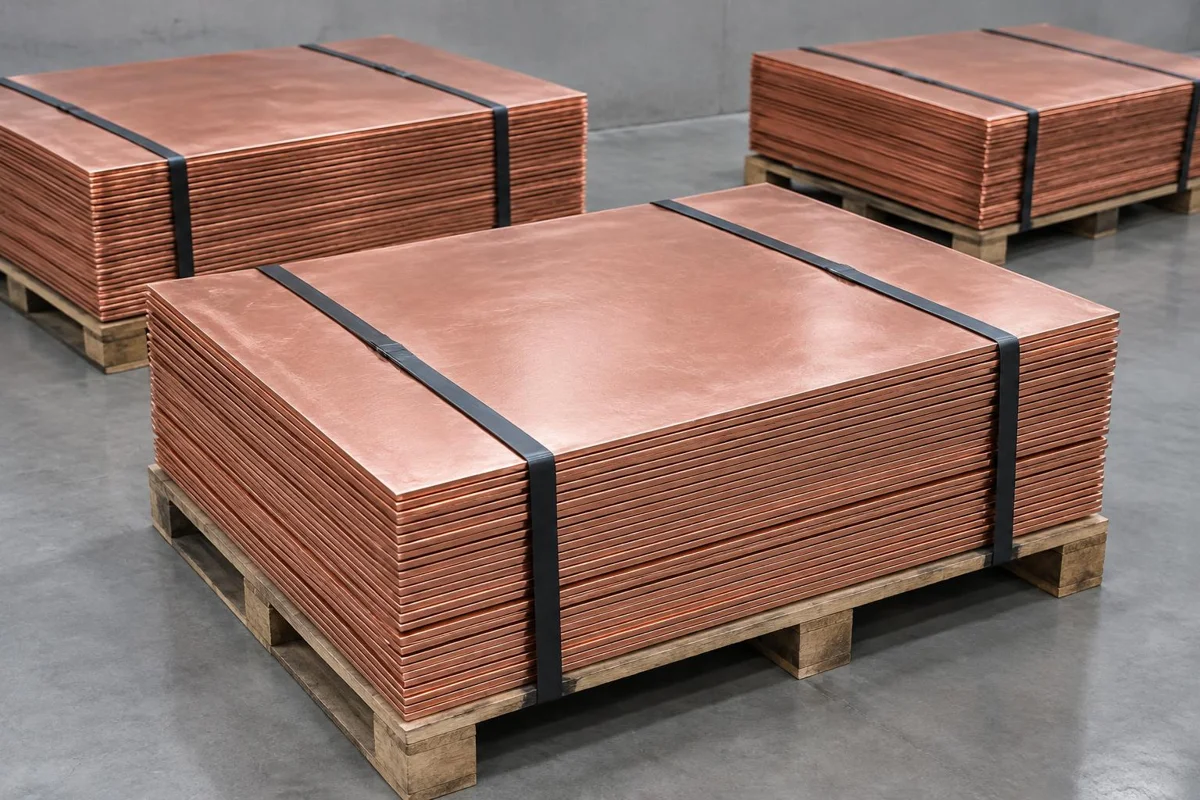
Copper cathode is predominantly elemental Cu, rather than copper-bearing sulphide or carbonate minerals. Its reddish metal sheets can show deposition texture and nodules. Appearance helps identify handling condition, but cannot establish trace chemistry. Electrical and thermal applications depend on the quality of the copper produced from the cathode, so impurity control matters beyond a simple purity headline.
The LME's published Cu-CATH-1 composition table uses BS EN 1978:2022 and limits the sum of listed impurities to 0.0065%, implying copper of 99.9935% by difference. Individual and grouped limits must also be met. A rounded 99.99% number, XRF screen or partial certificate cannot establish full conformity. Specify the entire standard, analytical scope, detection limits and acceptance procedure in the purchase contract.
- Trace chemistry: bismuth, antimony, arsenic, lead, iron, nickel, selenium, tellurium and sulphur are examples of elements requiring agreed control, not an exhaustive specification.
- Grade distinction: Cu-CATH-1 is a cathode specification. It does not make a finished conductor oxygen-free, certified or suitable for every application.
- Physical acceptance: sheet dimensions, contamination, damage, strapping and bundle weights must match the identified lot's packing and inspection records.
Main uses: refined copper feed for manufacturing
Cathode supplies controlled refined-metal feed for copper fabricators. Wire-rod mills melt and cast copper before rolling it into rod for drawing. Other plants produce billets, tube, strip or alloy feed. The finished product requires its own chemistry, dimensions and performance checks. Cathode purchase specifications should therefore start with the buyer's melt practice and intended output, not a generic promise of high conductivity.
- Wire rod and conductors: feed for building wire, power cable and winding wire after appropriate casting and drawing.
- Copper semis: tube, sheet, strip and profiles for thermal, industrial and construction products.
- Alloy production: controlled copper feed for brass, bronze and other alloys with separately specified alloy chemistry.
Primary applications: where fabricated copper goes
Copper's electrical conductivity, heat transfer and formability support power, transport, construction and industrial equipment. Cathode is upstream of these uses; it is not installed directly in a motor or solar panel. Suitability follows the downstream copper grade, manufacturing process and finished-product standards. No single cathode certificate proves compliance of a complete electrical system.
- Power and electronics: grid conductors, transformer windings, motor windings and electronic interconnections.
- Energy and transport: renewable-energy wiring, charging infrastructure and vehicle electrical systems, subject to design specifications.
- Thermal and building services: heat exchangers, cooling equipment, plumbing and selected architectural products in suitable copper grades.
Production process: electrorefining and electrowinning
In a common sulphide route, mined ore is crushed, ground and concentrated by flotation. Smelting and converting produce copper that is cast into anodes. During electrorefining, copper dissolves from the anode into an electrolyte and deposits at the cathode. Impurities are managed through anode-slime recovery, electrolyte treatment and process controls. The harvested cathode is refined metal, unlike the earlier concentrate.
In a suitable leach route, copper is dissolved from the feed, the solution is purified and concentrated, often by solvent extraction, and electrowinning deposits copper using electrical current. This SX-EW pathway is important for suitable oxide ores and some other leachable feed. Actual ore chemistry, extraction technology and plant design determine the route. Electrowon does not automatically mean low quality, and electrorefined does not automatically establish the contracted grade.
Global distribution & mining: ore origin is not refinery origin
Copper mining spans South America, Africa, Asia, North America and Australia. Chile and Peru are major Andean producers; the Democratic Republic of the Congo and Zambia are important in the Central African Copperbelt. China, the United States and Australia also contribute to mine supply. Porphyry and sediment-hosted deposits support different ore grades and processing routes. A mining map explains geology and feed supply, not a verified cathode shipment.
Refining geography is different from mining geography. China is a major copper refining center and processes domestic and traded feed. Refineries can use primary mined material and secondary copper sources; electrowinning plants recover metal from leach circuits. Mine output, smelter output, refined output, exports and reserves are separate statistics. Do not present contained-copper mine tonnes as cathode tonnes or infer a batch's refinery from the seller's address.
- Source verification: distinguish mine or feed origin, refinery country, producer brand, warehouse location and export country in the lot file.
- Statistics reference: USGS Copper Statistics and Information separates production stages; national totals are not evidence of Souq Ore stock or export authority.
Quality verification, traceability & title
Independent inspection should connect the report to the actual material. Match producer marks, bundle numbers, batch references, packing schedule and warehouse location. Verify certificates through the issuer where practical, agree representative sampling and retain sealed samples if disputes may arise. A surface XRF reading can assist screening but does not replace validated trace-level analysis of a representative lot or the complete standard's impurity limits.
Quality is only one part of a defensible purchase. Verify the counterparty, beneficial ownership, lawful source, sanctions exposure and authority to sell the identified material. Confirm warehouse access and title evidence independently before transferring funds. The contract should allocate inspection rights, risk transfer, ownership transfer, release conditions and claims deadlines. Neither exchange brand status nor a photograph proves that a seller owns a shipment.
How much is 1 kilogram of copper cathode worth?
There is no permanent USD price for one kilogram of copper cathode. Physical contracts may reference an LME cash price, a forward price or an agreed pricing-period average, with a negotiated premium or discount for the material and delivery basis. Identify the exact reference and date before comparing quotations. LME official copper prices are expressed in US dollars per metric tonne, not per kilogram.
Simplified cathode price per kg = (USD/tonne copper benchmark + signed USD/tonne physical premium) ÷ 1,000. A discount is a negative premium. Multiply this per-kg price by the accepted net metal kilograms to obtain the metal invoice component. State separately any freight, insurance, finance, currency conversion, taxes, duties or service charges not already included in the quoted Incoterm basis. Avoid counting included transport costs twice.
Hypothetical arithmetic only: an assumed USD 10,000/tonne benchmark plus an assumed USD 200/tonne premium equals USD 10,200/tonne, or USD 10.20/kg. For 20,000 kg of accepted net cathode, the metal component would be USD 204,000 before any additional costs. These invented inputs demonstrate unit conversion; they are not today's market, an offered premium, a minimum order or a load-capacity guarantee.
Cathode is already refined metal, so do not multiply its price by an ore-style 25% copper assay, apply concentrate moisture deductions or automatically subtract TC/RC. Packaging and straps are excluded through net-weight reconciliation rather than a wet-tonne concentrate formula. Any off-spec discount, rejection or alternative settlement must be expressly agreed for the tested lot.
Bulk purchase & wholesale export requirements
- Corporate RFQ: state company identity, intended use, requested standard and edition, acceptable brands, tonnes, delivery point and inspection requirements. Do not upload sensitive identity or banking files through public forms.
- Offer comparison: normalize the benchmark, pricing period, currency, premium, net-weight basis and Incoterm. A lower headline price can exclude freight, insurance or destination costs that another offer includes.
- Logistics: confirm bundle dimensions and weights, handling equipment, pallet and strapping condition, payload limits and securing. Do not assume a fixed container tonnage or a confirmed air-freight route for dense metal cargo.
- Customs preparation: the shipment's form, destination rules and origin documents determine classification and required permissions. Refined cathode and scrap are different goods; the buyer's clearing agent must confirm the applicable code, tax and documentation.
- Payment and title: agree banking instrument, inspection conditions, release milestones, risk allocation and ownership transfer. Verify counterparties and issuer documents independently; no certificate, photograph or website description guarantees payment safety.
- Acceptance and claims: fix sampling rights, laboratory scope, weight tolerance, rejection terms, retained samples and dispute resolution before dispatch. Current availability and shipment timing are confirmed in writing, not inferred from a reference image.
PRODUCT INQUIRY
Inquire about this item
Copper cathode
TEST CONTROL
From lot identity to buyer acceptance.
- 01
Verify source
Identify producer, batch, seller authority, warehouse and legal origin before discussing payment.
- 02
Inspect & analyse
Agree representative sampling, chemical limits, sheet inspection and independent report verification.
- 03
Weigh & contract
Reconcile net metal, packing, price basis, payment conditions and title transfer for the identified lot.
- 04
Load & accept
Document bundle counts, seals and loading; reconcile destination checks under the agreed claims procedure.
LOT FILE
Expected transaction records
- Producer and batch specification with the agreed standard and grade
- Authentic certificate of analysis and independent inspection report where commissioned
- Origin, ownership and authority-to-sell evidence for the identified lot
- Net-weight record, bundle schedule and loading evidence
- Commercial invoice, packing list and transport documents when issued
- Applicable export and destination documentation confirmed per shipment
Documents are released only when they exist for the identified lot and only to qualified parties through the secure channel.
DIRECT TECHNICAL ANSWERS
Buyer FAQs
What is copper cathode?
Copper cathode is electrolytically deposited refined copper metal, usually supplied as sheets for remelting and fabrication. It is produced by electrorefining or electrowinning and is distinct from ore, concentrate and copper wire scrap.
What purity does Grade A copper cathode mean?
The LME Cu-CATH-1 reference lists a maximum 0.0065% total for specified impurities, implying 99.9935% copper by difference, with individual impurity limits also required. A generic 99.99% claim is not enough to prove full compliance, and this reference is not a guarantee for any Souq Ore lot.
Is ASTM B115 the same as Cu-CATH-1?
No. They are distinct specifications. ASTM B115-24 covers electrorefined and electrowon cathode; the LME recognizes ASTM B115 Grade 1 as an alternative within its rules. State the exact edition and grade and check the complete composition limits rather than treating names as synonyms.
How much is 1 kilogram of copper cathode worth?
Divide the agreed USD-per-tonne copper benchmark plus the physical premium or discount by 1,000. The result depends on the pricing date or period, brand, destination and delivery terms. The USD 10.20/kg example below is hypothetical, excludes extra landed costs and is not a current Souq Ore quote.
What are the main uses of copper cathode?
Cathode is remelted into wire rod, billets, tube, sheet or alloy feed. Downstream applications include power cables, motors, transformers, electronics, heat exchangers, plumbing and copper alloys. Finished-product chemistry and performance requirements still apply.
Is every Grade A cathode LME approved?
No. Grade conformity and LME brand listing are separate matters. Verify the exact producer and brand on the official current list if exchange deliverability is required. A chemical report or seller label does not establish brand approval, warehouse stock or title.
Where is copper cathode produced?
Cathode is produced in refineries and electrowinning plants, which need not be in the country where the ore was mined. China is a major refining center; Chile and the Central African Copperbelt are important mining and metal-production regions. National statistics do not verify the origin of a particular offered batch.
How and where can I buy bulk copper cathode?
Submit a corporate RFQ to Souq Ore with the standard and grade, acceptable producer or brand, tonnes, delivery port or plant, pricing preference and inspection requirements. Confirm lot availability, seller authority, analysis, net weight and signed commercial terms before payment. This is an enquiry process, not an instant retail checkout.
Does cathode use concentrate TC/RC deductions?
Do not apply a concentrate formula automatically. Cathode is already refined metal and physical contracts commonly use a copper benchmark plus or minus a premium. Payability, dry-basis ore assay and concentrate moisture calculations belong to a different product and contract.
What are the sheet size, bundle weight and minimum order?
They are producer- and lot-specific. Souq Ore does not advertise universal dimensions, fixed bundle weights, monthly tonnage or a permanent minimum order. The written offer confirms packing, quantity tolerance, loading window and delivery terms for verified material.
Can copper cathode be used directly as finished electrical wire?
No. It must be melted, cast and drawn or otherwise fabricated into the required conductor form. Cathode chemistry does not replace finished-wire conductivity, mechanical testing, dimensional control or cable-system certification.
Which delivery gateways apply to bulk cathode?
Name a suitable seaport, warehouse or receiving plant in the RFQ. Airport codes elsewhere on this site describe broader buyer markets, not confirmed bulk-cathode routes. Shipment mode, payload, permits, customs classification and final receiving arrangements are reviewed per transaction.
OTHER COMMODITIES