
ROUGH DIAMONDS · PARCEL CONTROL
Conflict-free rough diamond parcels from East Africa
Parcel-controlled natural rough diamond supply for qualified cutters, manufacturers and licensed traders, handled under applicable Kimberley Process requirements and buyer-agreed independent inspection.
For licensed diamond traders, cutters and jewellery manufacturers
AT A GLANCE
What does Souq Ore supply as natural rough diamonds?
Parcel-controlled natural rough diamond supply for qualified cutters, manufacturers and licensed traders, handled under applicable Kimberley Process requirements and buyer-agreed independent inspection.
| Origin | Tanzania and Kenya |
|---|---|
| Buyer profile | For licensed diamond traders, cutters and jewellery manufacturers |
| Tests and checks | Parcel identity · Weight & count · Physical assortment · Natural origin · Trade compliance |
| Lot documents | 4 document types per lot, released after KYC |
| Delivery gateways | KWI · MCT · BAH · DOH · RUH · JED · DXB · AMM · JFK · LAX · BKK · PVG · PEK · HKG · NRT · HND · TPE |
| Commercial basis | Lot-specific, under signed contract after KYC and due diligence |
TECHNICAL CONTEXT
One parcel. One seal trail. One defensible record.
Rough diamonds are controlled and traded as defined parcels. Weight, stone count, physical description, seal references and custody events must reconcile before valuation language means anything.
The Kimberley Process Certification Scheme governs international trade in rough diamonds between participating states. Documentation is shipment-specific. It does not replace buyer due diligence, gemological testing, valuation or destination-country import approval.
SPECIFICATION FRAMEWORK
What is measured. How it is tested. What governs acceptance.
| Parameter | Test / inspection method | Acceptance basis |
|---|---|---|
| Parcel identity | Parcel reference, images and tamper-evident seal record | Exact parcel matched at every handover |
| Weight & count | Calibrated carat scale and controlled stone count | Recorded per parcel before valuation |
| Physical assortment | Visual sorting for size, shape, colour, clarity characteristics and inclusions | Buyer-agreed parcel description; no universal grade implied |
| Natural origin | Gemological testing by an appointed independent laboratory where required | Lot-specific report and agreed detection scope |
| Trade compliance | KP certificate and seal reconciliation; destination document review | Certificate tied to the specific export shipment |
ROUGH DIAMOND BUYER GUIDE
From natural crystal to a documented buying decision.
What is Rough, Uncut, and Raw Diamond?
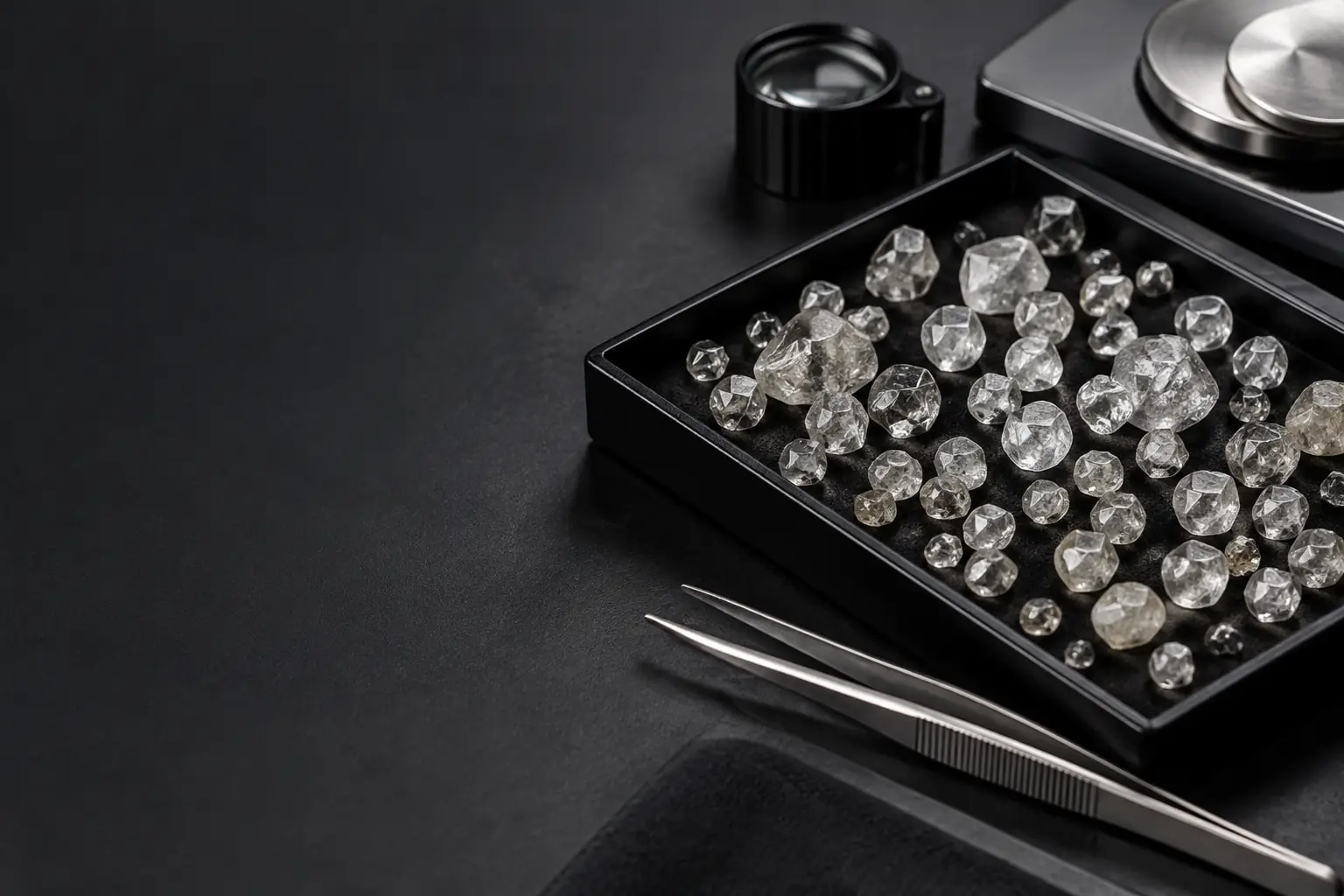
A polished diamond is engineered for light. A rough diamond is judged before that transformation: by crystal form, integrity, inclusions, colour, dimensions and probable cutting yield. It may resemble quartz or corundum to an untrained eye. Appearance alone is not identification, and sparkle is not a specification.
“Rough,” “uncut” and “raw” describe diamond material that has not been fashioned into a polished gem. For a manufacturer, the real question is harder: what polished outcome can this exact crystal produce, and what evidence supports its natural origin and lawful trade?
Identifying Natural Rough and Raw Diamond
Natural diamonds crystallize deep within the earth under extreme pressure and temperature, then reach the surface through rare volcanic events. The recovered crystal is the rough diamond traded between miners, dealers, cutters and manufacturers. A polished retail shape is a different product.
Rough material spans colourless, near-colourless and coloured crystals. Surface texture, skin, inclusions and crystal habit can conceal what lies inside. That uncertainty is why professional buyers combine visual examination with parcel-appropriate gemological testing instead of buying from photographs or colour language alone.
Feathers, clouds, fractures and colour zoning are not romantic details; they influence durability, planning and recoverable value. Each feature belongs in the parcel record before valuation.
Diamond ranks 10 on the Mohs hardness scale, but hardness is not proof of identity. Scratch testing can damage material and cannot support a commercial representation by itself. Verification should use suitable gemological observation and instrumentation under the agreed inspection protocol.
Types and shapes of rough diamonds
Natural raw diamonds are found in a variety of colors and shapes which are called fancy color diamonds. Rough diamonds exist in pink, yellow, cognac, brown, blue, green, gray black, and other colors. The most relevant shape is an octahedron.
It looks like pyramids fixed together on both sides of a raw diamond. Some shapes are different than octahedrons, other irregular rough diamonds like triangles, rough sphere balls, and mackles look like glass-like surfaces and reflect more light inside. Raw diamond cubes are exactly shaped as they are named; a fully formed cube has a surface similar to a raw diamond ball. Cubes can look opaque matte, and they have texture on surfaces like tiny clear crystals.
How can I use rough diamonds in jewelry making?
Rough diamonds can be preserved as natural crystals, partially fashioned or planned for full cutting. Designers use them in rings, earrings, bracelets, pendants and multi-stone pieces; manufacturers may instead acquire a parcel for calibrated polished production. The setting must respect the crystal’s cleavage, fractures and irregular geometry. The stone dictates the design. Never the reverse.
Where to buy natural rough raw diamonds?
Rough diamonds come from mines where legal mining is allowed by the government. Mine production is dispatched to diamond cutters and polishers worldwide, and international rough-diamond shipments are regulated through the Kimberley Process Certification Scheme (KPCS).
Souq Ore handles natural rough-diamond parcels on a transaction-specific basis. Documentation, origin, inspection, export clearance and Kimberley Process status are verified for the parcel before any compliance representation is made. Secure delivery is arranged under contract through an appointed Brinks, Malca-Amit or G4S-class carrier to KWI, MCT, BAH, DOH, RUH, JED, DXB or AMM.
Technical note: a scratch test alone does not prove that a stone is diamond. Souq Ore relies on parcel-appropriate verification before making a commercial representation.
BUYER FAQS
Shipping, payment, cancellation and claims
Shipping policy
- How much time will the order take to be delivered?
- Transit time starts with document readiness. A courier promise starts nothing. The signed quotation or contract states the dispatch and delivery window after export clearance, secure-carrier capacity, route and destination customs requirements are confirmed. Shipment uses an appointed Brinks, Malca-Amit or G4S-class carrier.
- What payment methods do you accept?
- Payment is accepted by bank transfer from a verified corporate account under the mechanism stated in the signed contract. Souq Ore does not accept cash.
- Are the prices inclusive of taxes?
- Taxes, duties, clearance charges and delivery costs are stated in the quotation and applied according to the destination country's laws. They may change when government tax or customs rules change.
- Can the shipping address be changed?
- The approved delivery point may be modified before the parcel is sealed and booked with the secure carrier, subject to compliance review. No change is accepted after custody and dispatch documents are finalized.
- What is the shipping cost on each order?
- Shipping is quoted per transaction according to parcel value, weight, insurance, secure-carrier route and destination. The complete charge is disclosed before contract signature.
International shipping
- Do you accept orders from other countries?
- Souq Ore serves qualified B2B buyers in Kuwait, Oman, Bahrain, Qatar, Saudi Arabia, the United Arab Emirates and Jordan, subject to KYC, sanctions screening, permits and route feasibility.
- What are the shipping costs for international orders?
- International shipping costs are calculated for the contracted route and are shown in the quotation. Souq Ore does not publish a flat fee because secure cargo, insurance and customs handling vary by parcel.
- Is return possible on international orders?
- Any return or rejection right is governed by the signed contract, inspection record and chain-of-custody requirements. A buyer must not return a controlled mineral shipment without written authorization and routing instructions from Souq Ore.
- What additional costs are applicable on international shipping?
- Duties, taxes, brokerage, storage or inspection charges imposed in the destination country are allocated in the contract. Final treatment is confirmed for the shipment with the buyer's licensed clearing agent.
Cancellation policy
- Once I place an order, can I cancel it?
- Cancellation is possible only as provided in the signed contract. Once a parcel has been sealed, insured, placed into secure custody or dispatched, cancellation may be unavailable and committed costs may remain payable.
- How many cancellations are acceptable?
- Repeated cancellations are reviewed during counterparty risk assessment and may affect whether Souq Ore accepts future orders.
Return and damaged goods policy
- Are the products refundable?
- Refund eligibility is determined by the signed contract, agreed specification, inspection evidence and acceptance procedure. A change of mind is not an automatic basis for refunding a B2B mineral transaction.
- What is the return process?
- Send the contract reference, inspection record and reason for the request to sales@souqore.com. If authorized, Souq Ore issues secure-carrier and chain-of-custody instructions. The buyer must not ship the parcel independently.
- What is the time period in which a return request must be filed?
- The notification and claim period is stated in the signed contract and begins at documented custody handover. Notify Souq Ore immediately when any discrepancy is discovered.
- What should I do if a damaged or defective order is received?
- Do not open, alter or transfer the parcel outside the agreed inspection protocol. Record the seal, packaging and condition, notify sales@souqore.com immediately, and preserve all custody and carrier documents.
- On what grounds can a damage or discrepancy claim be filed?
- A claim must be supported by the intact seal record, carrier handover documents, photographs, inspection evidence and the contract specification. Natural color, inclusion or morphology disclosed and accepted before shipment is not a transport-damage claim.
- How will an approved claim be carried out?
- Souq Ore reviews the evidence with the appointed carrier, insurer and inspection parties. Any replacement, return, price adjustment or refund then follows the remedy stated in the signed contract.
- Who pays shipping charges on an approved return?
- Responsibility for secure return freight, insurance, duties and handling follows the signed contract and the cause established by the documented claim review.
Review: Shipping policy · Return policy · Request a quote
PRODUCT INQUIRY
Inquire about this item
Natural rough diamonds
TEST CONTROL
From lot identity to buyer acceptance.
- 01
Register parcel
Record parcel reference, stone count, weight, images and initial seal.
- 02
Inspect
Conduct controlled visual sorting and buyer-agreed gemological checks.
- 03
Reconcile documents
Match the shipment-specific KP document, export file and seal references.
- 04
Accept & reseal
Document buyer acceptance, reseal where required and continue the custody log.
LOT FILE
Expected transaction records
- Parcel schedule and image register
- Weight, count and seal record
- Shipment-specific KP documentation
- Independent inspection report where appointed
Documents are released only when they exist for the identified lot and only to qualified parties through the secure channel.
DIRECT TECHNICAL ANSWERS
Buyer FAQs
Does every parcel have a Kimberley Process certificate?
A KP certificate applies to a specific international rough-diamond shipment and is reviewed before export. We do not present a blanket certificate as covering future parcels.
How are rough diamonds graded?
A parcel may be sorted by carat weight, size, shape, colour and clarity characteristics, with value also influenced by recoverable polished yield. The exact protocol is agreed for the parcel.
Can an independent laboratory test natural origin?
Yes, where required by the buyer and contract. The laboratory, scope, sample handling and report are appointed for that transaction.
Does KP documentation replace AML checks?
No. KP controls rough-diamond trade between participating states. Counterparty, beneficial-owner, payment and source checks remain separate requirements.
OTHER COMMODITIES